Planning a mobile marketing tour requires coordinating six core elements: route strategy, vehicle selection and customization, staffing, location permitting, logistics and supply chain, and performance measurement. When these elements align, a mobile tour delivers direct consumer engagement in dozens of markets with far greater efficiency than running separate activations in each city.
Step 1: Define Campaign Objectives and Audience
Before any logistics planning, establish exactly what the tour is designed to achieve. Whether driving trial, building awareness in new markets, generating leads, supporting retail, or earning social media content determines route design, stop selection, consumer experience design, and staffing requirements. A trial generation tour and an earned media tour are fundamentally different programs.
Step 2: Design the Route
Route design balances market priority with logistics efficiency. Key considerations include market prioritization (which cities are most important to your brand's growth strategy), geographic efficiency to minimize dead-head travel, and stop duration to balance market coverage with depth of engagement.
A typical national tour might cover Los Angeles, Las Vegas, Phoenix, Denver, Dallas, Houston, New Orleans, Atlanta, Miami, Orlando, Philadelphia, Boston, New York, and Chicago over 6-12 weeks.
Step 3: Select and Customize the Vehicle
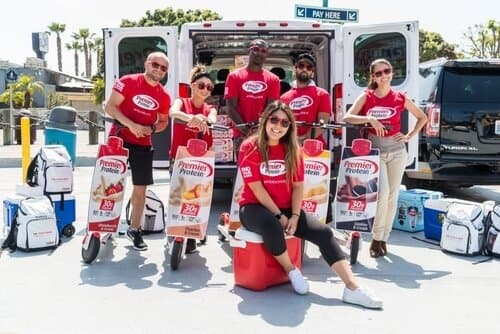
The tour vehicle is the primary consumer experience touchpoint. Options include branded trailers or semis for maximum interior space, branded vans or sprinters for nimble cost-efficient activations, branded step vans or food truck conversions common for food and beverage sampling, branded double-deckers for high visual impact, and custom fabricated installations for premium brands seeking distinctive visual statements.
Vehicle customization lead times are typically 8-16 weeks for full vinyl wraps and experience installations. Build this into your planning timeline.
Step 4: Staff the Tour
Tour staffing options include a traveling core team that provides consistency but creates fatigue on long tours, local market staffing through a brand ambassador agency in each market that provides fresh energy at each stop and eliminates travel costs, and a hybrid model combining a traveling manager with local staff at each stop to balance consistency with cost efficiency.
Air Fresh Marketing's mobile marketing tour capabilities include national staffing networks that can supply trained local ambassadors in every major market, eliminating the need to fly staff across the country.
Step 5: Secure Permits and Locations
Mobile tours require location permits in nearly every city for commercial activity on public property. Major city permit offices have processing times of two to six weeks. Some locations require insurance certificates naming the city as additionally insured. Parks, downtown corridors, and special event areas often have blackout dates. Retailer parking lot activations require retailer permission and sometimes regional or corporate approval.
Begin permit applications the moment your route is finalized. Never wait until the week before a stop.
Step 6: Plan Logistics and Supply Chain
Every tour stop requires sufficient product inventory for the planned consumer interaction volume, a replenishment strategy for high-volume stops, an equipment maintenance plan for the vehicle and activation infrastructure, waste and disposal protocols for consumable samples, and uniform inventory and replacement plans for staff.
Step 7: Build a Measurement Framework
Define how you'll track performance at every stop: consumer interactions per hour, samples distributed, leads captured, social content generated, and unique tracking code redemptions. This data enables route optimization in real time and builds the learning base for future tours.
Contact Air Fresh Marketing to discuss your mobile marketing tour, or get a quote. Our experiential marketing agency has planned and executed multi-market mobile tours for national consumer brands.